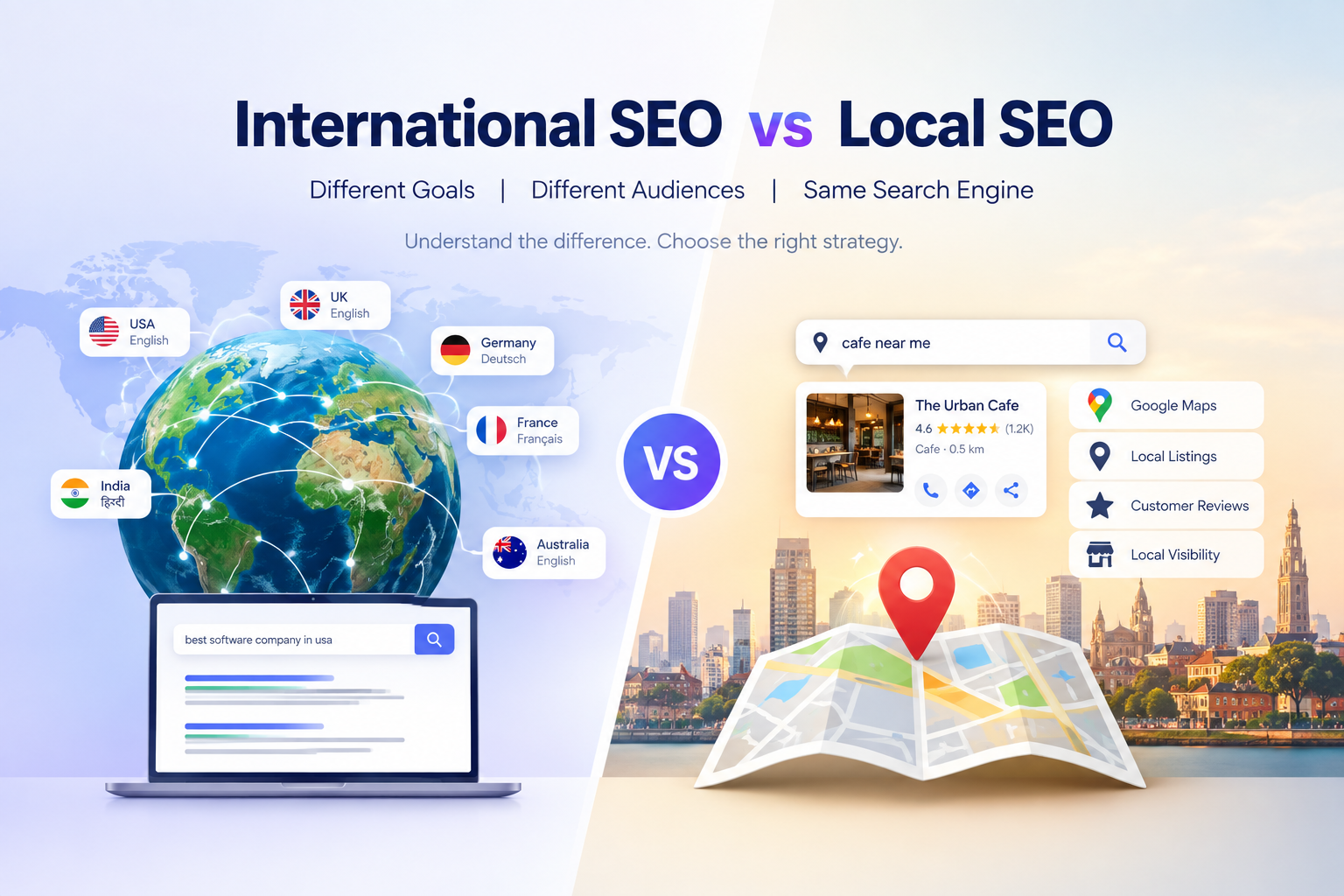
Search engine optimization is not a one-size-fits-all strategy. The right SEO approach depends heavily on where your customers are, what you offer, and how they search for your business.
Two important SEO strategies businesses often need to understand are International SEO and Local SEO.
While both aim to improve visibility on search engines like Google, their objectives, targeting methods, technical requirements, and content strategies are quite different.
If your business operates across multiple countries, International SEO may be the right approach. If you primarily serve customers in a specific city or geographic area, Local SEO is likely more important.
Let’s understand the difference.
What Is International SEO?
International SEO is the process of optimizing a website so that it can rank in search results across multiple countries, regions, or languages.
The objective is to make sure search engines understand:
- Which countries you serve
- Which language each page targets
- Which version of your website should appear to users in different locations
- Which products or services are available in each market
For example, imagine an e-commerce company selling products in:
- India
- United States
- United Kingdom
- Germany
- Australia
The company may need different content, currencies, languages, shipping information, and search strategies for each market.
This is where International SEO becomes important.
Example
A company targeting India might optimize for:
“industrial machinery suppliers in India”
While its US strategy could target:
“industrial machinery suppliers in USA”
Although the products may be similar, the search intent, competition, terminology, and customer expectations can vary between markets.
What Is Local SEO?
Local SEO focuses on improving a business’s visibility for searches connected to a specific geographic location.
It is particularly important for businesses that serve customers within a particular city, region, or service area.
Examples include:
- Restaurants
- Hotels
- Doctors and clinics
- Real estate companies
- Lawyers
- Salons
- Local retailers
- Home service businesses
- Gyms
- Educational institutes
A local customer might search:
“best dentist near me”
or:
“SEO agency in Ahmedabad”
or:
“restaurants near Ahmedabad airport”
Local SEO helps businesses appear in relevant local search results, including Google’s local results and Google Maps.
International SEO vs Local SEO
The easiest way to understand the difference is through the target audience.
FactorInternational SEOLocal SEOPrimary TargetMultiple countries/regionsSpecific city, region, or service areaMain GoalGlobal or multi-country visibilityLocal customer acquisitionGeographic FocusCountries and regionsCities, neighborhoods, and service areasLanguage TargetingOften importantUsually less complexGoogle Business ProfileMay support local officesExtremely importantHreflangOften importantGenerally not requiredLocal CitationsMarket-dependentVery importantLocation PagesCountry/region focusedCity/service-area focusedKeyword StrategyCountry/language basedLocation + service basedExample”SEO agency in UK””SEO agency in Ahmedabad”
1. Geographic Targeting
One of the biggest differences is geographic targeting.
International SEO
International SEO can target multiple countries.
For example:
- India
- USA
- UK
- Canada
- UAE
A website may have dedicated versions for different markets.
For example:
example.com/in/
example.com/us/
example.com/uk/
example.com/ae/
Alternatively, businesses may use country-specific domains such as:
example.in
example.co.uk
example.ae
The right structure depends on the business, technical setup, branding, and SEO strategy.
Local SEO
Local SEO usually focuses on a much smaller geographic area.
For example:
SEO Agency in Ahmedabad
could target customers in:
- Ahmedabad
- Gandhinagar
- Bopal
- Satellite
- Prahlad Nagar
The objective isn’t to rank globally. It is to become highly visible when potential customers in the target area search for relevant products or services.
2. Keyword Strategy
Keyword research is important for both strategies, but the way keywords are targeted differs.
International SEO Keywords
International SEO may involve country-specific variations.
For example:
India:
digital marketing agency India
United States:
digital marketing agency USA
United Kingdom:
digital marketing agency UK
The strategy should go beyond simply adding a country name.
Search behavior can vary between markets. People may use different terminology for the same product or service.
For example, a product may have different names or spelling variations depending on the country.
Therefore, international keyword research should consider:
- Search volume
- Search intent
- Local terminology
- Competition
- Language
- Cultural differences
- Search trends
Local SEO Keywords
Local SEO focuses heavily on location-based search terms.
Examples:
plumber in Ahmedabad
best cafe in Ahmedabad
dentist near me
digital marketing agency in Ahmedabad
hotel near Somnath Temple
These keywords combine service/product intent with geographic intent.
3. Google Business Profile
Google Business Profile is one of the most important components of Local SEO.
A properly optimized profile can help businesses appear in:
- Google Maps
- Local Pack
- Local search results
- Branded searches
- Service-related local searches
Businesses should pay attention to:
- Business name
- Primary category
- Secondary categories
- Address/service area
- Phone number
- Website
- Business description
- Services
- Photos
- Posts
- Reviews
- Business hours
For a business that depends heavily on local customers, Google Business Profile optimization can be a major part of the SEO strategy.
International SEO, on the other hand, may not rely on Google Business Profile as its primary growth mechanism—especially for businesses that operate online across multiple countries without physical locations.
4. Hreflang and Language Targeting
One of the major technical differences between International SEO and Local SEO is language and regional targeting.
International websites may have multiple language or regional versions.
For example:
example.com/en-us/
example.com/en-gb/
example.com/fr/
example.com/de/
Search engines need clear signals about which version should be shown to users.
This is where hreflang implementation can become important.
Hreflang helps communicate relationships between localized versions of pages.
For example:
This page is intended for English-speaking users in the United States.
while another version may target:
English-speaking users in the United Kingdom.
Incorrect implementation can create indexing, duplication, or targeting problems.
Local SEO typically does not require this level of international language targeting.
5. Content Strategy
Content plays a major role in both strategies, but the content should reflect the audience.
International SEO Content
International content may require:
- Country-specific landing pages
- Localized product pages
- Regional blogs
- Country-specific guides
- Market-specific case studies
- Local terminology
- Currency and shipping information
- Region-specific FAQs
Simply translating the same article into another language may not always be enough.
Localization is more than translation.
The content should feel natural to users in that particular market.
Local SEO Content
Local SEO content focuses more on geographic relevance.
Examples include:
Best Places to Visit in Ahmedabad
How to Choose an SEO Agency in Ahmedabad
Things to Know Before Visiting Somnath
Best Restaurants Near [Location]
Businesses can also create dedicated location pages for the areas they genuinely serve.
6. Link Building
Link building is important for both International and Local SEO, but the sources of links can differ.
International SEO
An international business may focus on acquiring backlinks from:
- Industry publications
- International media
- Country-specific websites
- Business publications
- Relevant blogs
- Industry directories
- Regional news websites
The goal is to build authority and relevance in different target markets.
Local SEO
Local businesses can benefit from:
- Local directories
- Local news websites
- Chamber of commerce websites
- Local business associations
- Community websites
- Regional publications
- Local partnerships
- Location-specific citations
For example, an Ahmedabad-based business may benefit from relevant websites and organizations connected to Ahmedabad and Gujarat.
7. Citations and Local Signals
Local citations are particularly important in Local SEO.
A citation generally refers to a business’s information appearing on external platforms, such as:
- Business directories
- Local directories
- Industry directories
- Review websites
- Maps
- Regional platforms
Consistency is important.
The business’s name, address, and phone number (NAP) should be accurate and consistent wherever applicable.
International SEO may also involve business directories, but its strategy is usually more focused on country-specific authority, relevance, language, and market signals rather than local citations alone.
8. Technical SEO Requirements
Both strategies require strong technical SEO, but International SEO can introduce additional complexity.
International SEO may require:
- Hreflang
- Country/language URL structures
- International domain strategy
- Geotargeting considerations
- Localized metadata
- International redirects
- Multiple XML sitemaps
- Regional content management
- Duplicate-content management
Local SEO may focus more on:
- Crawlability
- Indexation
- Core Web Vitals
- Mobile experience
- Structured data
- Location pages
- Internal linking
- LocalBusiness schema
- NAP consistency
- Google Business Profile integration
Technical SEO remains foundational in both cases.
9. Search Intent Is Different
Search intent can vary significantly between international and local searches.
Consider the keyword:
“SEO agency”
This could represent a broad research query.
But:
“SEO agency in Ahmedabad”
has a much stronger local intent.
Similarly:
“hotel in India”
is broader than:
“hotel near Somnath Temple”
The second query indicates a much more specific geographic requirement.
Understanding this difference helps businesses create pages that match the user’s actual intent rather than simply targeting keywords.
Can a Business Need Both International SEO and Local SEO?
Absolutely.
A business can use both strategies when it operates internationally but also has physical locations.
For example, imagine a hotel chain operating in:
- India
- UAE
- Singapore
- UK
The company could use:
International SEO
To target:
hotels in India
hotels in UAE
hotels in Singapore
Local SEO
To target:
hotels in Ahmedabad
hotels in Dubai
hotels in Singapore
This creates a layered SEO strategy:
Global → Country → City → Location
The key is maintaining a clear website architecture and avoiding unnecessary or duplicate location pages.
Which SEO Strategy Does Your Business Need?
The answer depends on your business model.
Choose International SEO if:
- You sell products or services internationally.
- You operate in multiple countries.
- You have customers from different regions.
- You need visibility in multiple languages.
- You have country-specific offerings.
- Your website receives international traffic.
- You want to expand into new markets.
Focus on Local SEO if:
- You serve customers in a specific city or region.
- You have a physical business location.
- Customers visit your business.
- You provide services within a defined area.
- Google Maps visibility is important.
- Your customers frequently use “near me” searches.
Consider both if:
- You have multiple physical locations.
- You operate in multiple countries.
- You have regional branches.
- You sell nationally but also have local stores.
- You have an international website with country-specific offices.
Common Mistakes to Avoid
Regardless of which strategy you choose, several mistakes can limit SEO performance.
International SEO mistakes
- Using the same content for every country
- Ignoring regional search behavior
- Incorrect hreflang implementation
- Automatically redirecting users based on IP
- Creating thin country pages
- Translating content without localization
- Using incorrect regional keywords
Local SEO mistakes
- Incomplete Google Business Profile
- Inconsistent business information
- Ignoring reviews
- Creating low-quality location pages
- Targeting locations the business doesn’t actually serve
- Ignoring local citations
- Having poor mobile website performance
- Focusing only on rankings instead of leads and calls
International SEO vs Local SEO: The Bigger Picture
The biggest difference is not simply “country vs city.”
It is about search relevance and user intent.
International SEO asks:
How can we make our website relevant and visible to users across different countries, regions, and languages?
Local SEO asks:
How can we make our business visible to customers searching for our products or services in a specific geographic area?
Both require keyword research, quality content, technical SEO, authority building, and continuous optimization.
The difference lies in how those elements are adapted to the target audience and geographic market.
Final Thoughts
Choosing between International SEO and Local SEO shouldn’t be based on which strategy sounds more advanced.
It should be based on where your customers are and how they search for your business.
A local restaurant doesn’t need an international SEO strategy just because it wants more traffic. Similarly, an e-commerce company selling across five countries shouldn’t limit its SEO strategy to one city.
The right strategy starts with understanding the business.
Identify the market. Understand the search intent. Build the right SEO structure. Then optimize for visibility, relevance, and conversions.
In SEO, ranking is only part of the objective.
The real goal is to reach the right audience in the right market at the right moment.