Today, I came home from Ahmedabad.
The moment I arrived, my four-year-old nephew came running toward me.
We talked for a while, played a little, and then, very casually, she said something that completely stopped me.
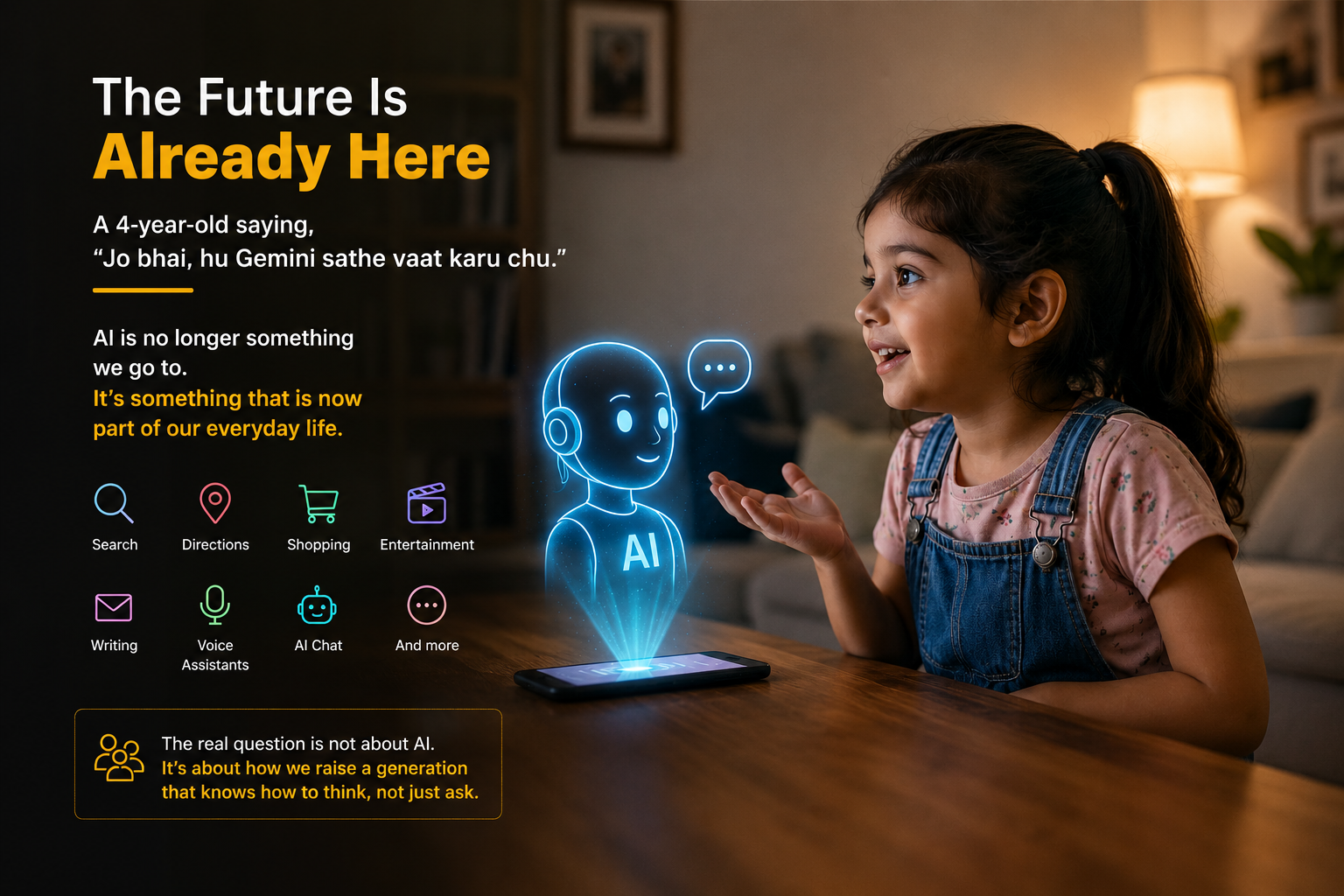
“Jo bhai, hu Gemini sathe vaat karu chu.”
In Gujarati, it simply means:
“Look brother, I talk to Gemini.”
I looked at her for a second.
She is just four years old.
And my first reaction was:
“What are you talking about with Gemini?”
I was genuinely shocked.
Not because she was using technology. Children today are surrounded by smartphones, tablets, smart TVs, voice assistants, and digital content.
But this felt different.
She wasn’t just watching something.
She was talking to AI.
And suddenly, a much bigger question came to my mind:
Is this a good thing for children, or are we slowly creating a generation that will depend on AI for everything?
AI Is No Longer Something “In The Future”
For years, we talked about artificial intelligence as something that would transform our future.
We imagined robots, autonomous cars, intelligent machines and futuristic workplaces.
But perhaps we misunderstood the timeline.
AI didn’t arrive one day with a big announcement.
It quietly entered our homes.
It started with recommendation algorithms.
Then voice assistants.
Then smart search.
Then AI-generated content.
And now, children can have conversations with AI.
That’s what makes the current AI revolution so different.
AI isn’t necessarily something we go to anymore.
Increasingly, it is something that is simply there.
Think About Your Own Day
You wake up and check your phone.
Your feed has already been personalized for you.
You search for a restaurant, and algorithms decide what you see.
You open YouTube, and recommendations are waiting.
You type an email, and AI suggests the sentence.
You open Google Maps, and algorithms calculate the best route.
You shop online, and AI predicts what you might want.
You take a photograph, and software automatically improves it.
You ask ChatGPT to explain something.
You ask Gemini to summarize something.
You use AI at work to write, research, analyze, brainstorm, or automate.
Most of the time, we don’t even stop to think:
“I am using artificial intelligence right now.”
That’s how quickly it has become normal.
And Now, Children Are Growing Up With It
This is the part that made my nephew’s sentence so interesting.
For adults, AI feels like a new technology.
For children, it may simply become normal technology.
We remember a time before smartphones.
Many children today don’t.
We remember searching for information manually.
They may grow up asking an AI.
We remember learning how to use computers.
They may grow up learning how to work with AI.
And that creates an important difference between generations.
For us, AI is something we adopted.
For them, AI may be something they never remember living without.
But Is That Dangerous?
Not necessarily.
The technology itself isn’t automatically good or bad.
The important question is:
How is it being used?
If a child asks AI to explain why the sky is blue, that could be an amazing learning experience.
If a child asks AI to create a story and then discusses the story with their parents, it could encourage imagination.
If AI helps a child explore questions that they are curious about, it can become a powerful educational tool.
But there is another side.
What happens when a child stops asking parents, teachers, or friends questions because AI is always available?
What happens when AI becomes the first answer to every question?
What happens when children stop struggling with a problem because they know a machine can solve it instantly?
And perhaps most importantly:
What happens to curiosity when answers become too easy?
The Real Risk Isn’t AI. It’s Dependency.
I don’t think the biggest danger is that children will talk to AI.
The bigger danger is that they may eventually depend on AI to think for them.
There is a huge difference between:
“AI helped me understand this.”
and
“AI thought about this for me.”
The first can make us smarter.
The second can make us dependent.
Children need to experience boredom.
They need to ask strange questions.
They need to make mistakes.
They need to argue with their friends.
They need to imagine things that don’t exist.
They need to solve problems without immediately receiving an answer.
These experiences are part of developing independent thinking.
AI should support that process — not replace it.
Maybe We Need a New Kind of Digital Parenting
Parents previously had conversations about:
“How much TV should my child watch?”
Then it became:
“How much screen time should my child have?”
Now perhaps we need another question:
“How should my child interact with AI?”
The answer cannot simply be banning it.
AI is becoming too deeply integrated into education, work and everyday life.
Instead, children need to learn how to question AI, verify information, think independently, and use technology responsibly.
Parents don’t necessarily need to understand every technical detail of AI.
But they should understand how their children are using it.
Coming Back to That Four-Year-Old
My nephew’s sentence lasted only a few seconds.
“Jo bhai, hu Gemini sathe vaat karu chu.”
But it made me think about something much bigger.
Maybe this is what technological change actually looks like.
It doesn’t always arrive dramatically.
Sometimes it walks into your home wearing a child’s smile.
Sometimes it appears in a four-year-old’s casual sentence.
And suddenly you realize:
The future we were talking about has already arrived.
The question isn’t whether children will grow up with AI.
They probably will.
The real question is:
Will we teach them how to use AI, or will we allow AI to teach them how to think?
Because there is a difference.
And perhaps that difference will define the next generation.
AI can answer a child’s questions.
But we still need to teach children how to ask better questions.